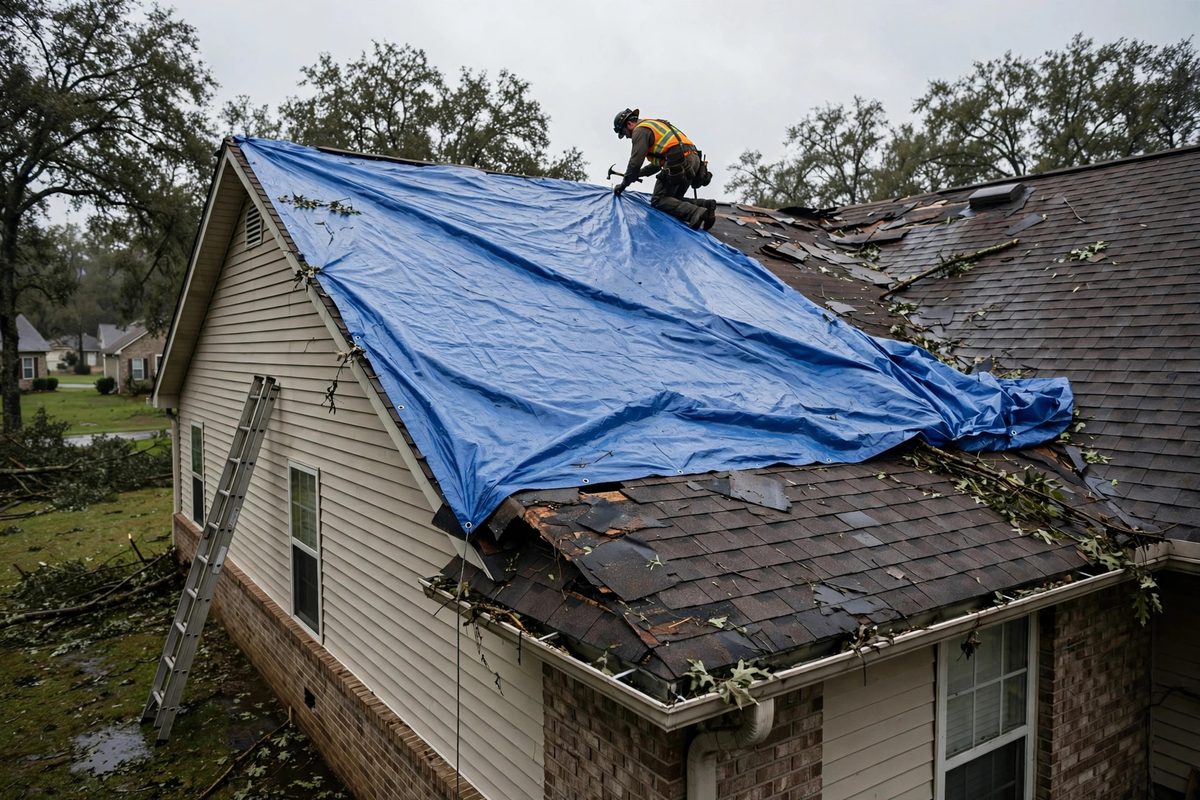
Storm damage restoration in Kennesaw, GA: emergency board-up, roof tarping, water extraction, and full repair after Georgia storms. 24/7 emergency response.
Kennesaw's 54.6 inches of annual rain do not fall gently or evenly. They arrive in patterns, and each pattern damages houses differently.
Spring severe storms (March–May). Tornadoes, straight-line winds, hail, and intense cloudbursts. This is roof damage season: lifted shingles, punctured decking, fallen limbs through roofs. Wind-driven rain enters through openings the storm created minutes earlier.
Summer downpours (June–August). Slow-moving thunderstorms that drop inches in an hour. Gutters overflow, grading gets overwhelmed, and red clay soil sheds water toward foundations instead of absorbing it. Basement seepage and window-well flooding spike.
Tropical remnants (August–October). Dying hurricanes stall over North Georgia and drop prolonged, saturating rain. The September 2009 flood that put Allatoona Creek at 1-in-500-year levels was this pattern. Multi-day rain finds every weakness a house has.
Winter ice (December–February). Ice storms snap limbs onto roofs and power lines. Freeze-thaw cycles open small roof vulnerabilities into real leaks.
We staff and equip for all four. When the forecast turns severe, our crews are staged, not scrambling.
---
1. Secure the openings. Board-up for broken windows and doors. Tarping for damaged roofs. Temporary weatherproofing for any breach. The goal is always the same: prevent the second loss. The water damage that follows the storm is usually worse than the storm damage itself.
2. Extract the water. Whatever got in comes out: commercial extraction for standing water, moisture mapping for what wicked into walls and ceilings. Storm water is Category 2 at best and often carries contaminants, so we scope it accordingly.
3. Document for insurance. Storm claims live or die on documentation. We photograph everything before we touch it, log the damage room by room, and build the file your adjuster needs. Date-stamped, meter-read, thorough.
4. Plan the rebuild. Roofing, siding, drywall, flooring: the permanent repairs sequenced correctly. Temporary protection stays until permanent repairs are weatherproof. No gaps where the next rain gets in.
---
we have seen homeowners skip straight to calling a roofer while water sat in the attic for a week. By the time the roof was fixed, the attic was a mold project. Secure, extract, document, rebuild: in that order, every time. ---
Board-up for broken windows and doors. Tarping for damaged roofs. Temporary weatherproofing for any breach. The goal is always the same: prevent the second loss. The water damage that follows the storm is usually worse than the storm damage itself.
Whatever got in comes out: commercial extraction for standing water, moisture mapping for what wicked into walls and ceilings. Storm water is Category 2 at best and often carries contaminants, so we scope it accordingly.
Storm claims live or die on documentation. We photograph everything before we touch it, log the damage room by room, and build the file your adjuster needs. Date-stamped, meter-read, thorough.
Roofing, siding, drywall, flooring: the permanent repairs sequenced correctly. Temporary protection stays until permanent repairs are weatherproof. No gaps where the next rain gets in. Why order matters: we have seen homeowners skip straight to calling a roofer while water sat in the attic for a week. By the time the roof was fixed, the attic was a mold project. Secure, extract, document, rebuild: in that order, every time. ---
H3: Roof leaks: tracing water to its source.
The stain on your ceiling is the end of the water's journey. Water enters at a roof vulnerability, travels along decking and framing, and shows up feet away from the entry point. Our protocol: trace the interior water path back to the source with moisture meters, assess the decking and insulation along the way, complete the interior drying and repair, and coordinate with your roofer on the exterior fix. We do the interior restoration. We make sure the roofer's scope matches what we found inside. Interior and exterior handled in the right sequence, by people who actually talk to each other.
H3: Board-up and tarping, day or night.
Broken window, torn roof section, kicked-in door after a storm: we secure it. Plywood board-up for openings, reinforced tarping for roof damage, temporary weatherproofing that holds until permanent repairs. This is often a middle-of-the-night service, and we treat it with middle-of-the-night urgency. A proper tarp job buys you weeks of protection. A bad one buys you a second insurance claim. We do proper ones.
---
Storm damage is never just storm damage. Here is the chain we see after every major weather event:
Storm opens the house → water gets in. The immediate job: board-up, tarping, extraction. Learn more
Water sits → mold starts. In Kennesaw's humidity, the 48-hour clock starts the moment water enters. Storm jobs that wait a week for "the roofer to get here first" become mold jobs. Our protocol runs mold prevention inside every storm response. Learn more
This chain is why our storm service exists as a full restoration offering, not just a tarp-and-go operation.
---
call the restoration company first, not the roofer first. We secure the structure AND handle the water AND prevent the mold, in the right order. The roofer fixes the roof. We make sure there is still a house worth roofing. This chain is why our storm service exists as a full restoration offering, not just a tarp-and-go operation. ---
---
Make sure everyone is safe and the structure is stable. Do not go on the roof. Call us for emergency tarping and board-up, then call your insurance. We secure it, document it, and handle the interior water damage while the tree and roof get addressed.
Typically yes for sudden storm events: wind, hail, fallen trees, wind-driven rain through storm-created openings. Gradual issues (long-term roof wear) are usually excluded. Documentation is everything, and we build it from the first visit.
Emergency tarping is a same-day service, often within hours. The tarp needs to survive until permanent repairs, so we do it properly: secured, overlapped, and anchored, not draped.
Both, and we handle both. The storm is the cause; the water is the problem. Our protocol covers the full chain: extraction, drying, mold prevention, and drainage guidance.
No. Mitigate first, document everything. Insurance expects you to prevent further damage. Waiting while water sits makes the damage worse and can complicate the claim. Photograph, then act. ---
Tell us what happened. We will call back shortly to schedule a look.
Call now for emergency response in Kennesaw and the Atlanta metro.
Call (770) 555-0100